SEBI & Financial Accessibility
WCAG, GIGW and IS 17802: Which Standards Apply to SEBI-Regulated Entities?
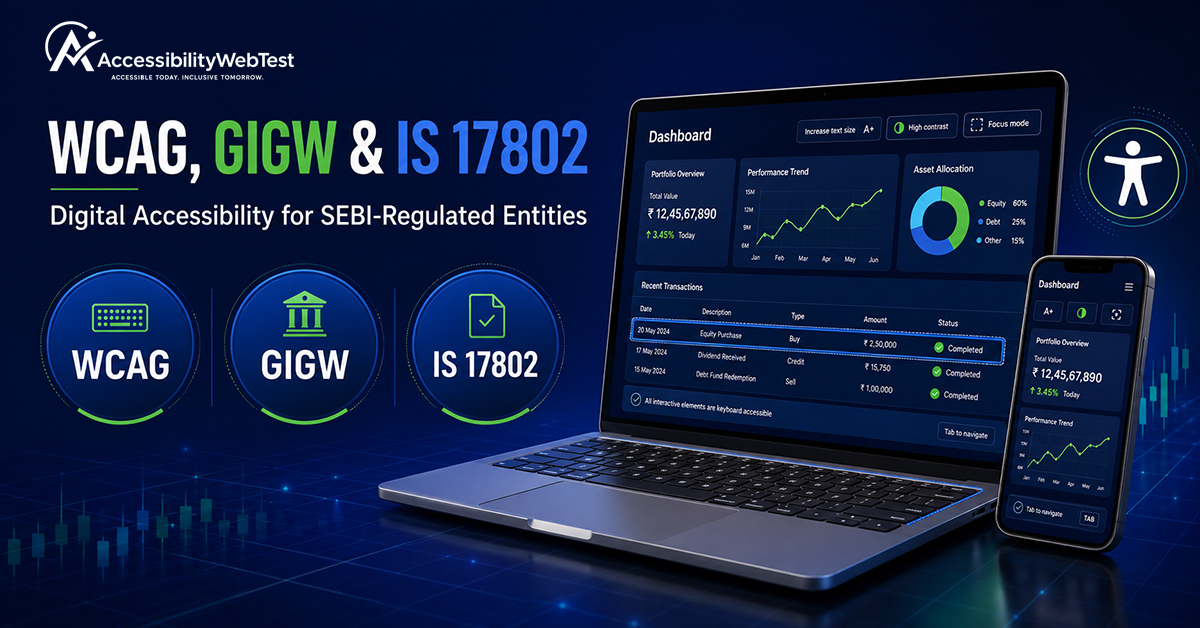
Digital accessibility is no longer simply a design preference for organizations operating in India’s securities market. It is becoming an important part of regulatory compliance, investor protection and responsible digital service delivery.
SEBI-regulated entities provide many essential services through websites, mobile applications, trading platforms, investor portals, digital KYC systems and electronic documents. If these platforms cannot be used by people with disabilities, investors may be unable to open an account, verify their identity, review financial information, place a transaction or raise a complaint independently.
The Securities and Exchange Board of India addressed this issue through its July 2025 circular concerning mandatory compliance with the Rights of Persons with Disabilities Act, 2016 and its corresponding rules. SEBI subsequently published additional compliance guidance and clarifications.
The framework refers to several accessibility standards and guidelines, including:
Web Content Accessibility Guidelines (WCAG)
Guidelines for Indian Government Websites and Apps (GIGW)
IS 17802, the Indian accessibility standard for ICT products and services
The Rights of Persons with Disabilities Act, 2016
This creates an important question for regulated entities: Should an organization follow WCAG, GIGW or IS 17802?
The practical answer is that these are not competing standards. Each one serves a different purpose, and SEBI-regulated entities should consider them together when building an effective digital accessibility programme.
Why digital accessibility matters to SEBI-regulated entities
An investor’s digital journey can involve several connected systems:
Visiting a website to understand a financial product
Creating an investor account
Completing identity verification and digital KYC
Using a mobile app or trading platform
Reading financial reports and account statements
Authorizing transactions
Contacting customer support
Submitting a complaint or grievance
A barrier at any one of these stages can prevent an investor with a disability from accessing the service independently. Common barriers include:
Form fields without accessible labels
Controls that cannot be operated using a keyboard
OTP screens that do not work properly with a screen reader
CAPTCHAs without accessible alternatives
Financial charts presented without text explanations
Insufficient colour contrast
Documents with an incorrect reading order
Mobile controls without accessible names
Session time limits that cannot be extended
Error messages shown visually but not announced by assistive technology
Accessibility must therefore be evaluated across the complete investor journey—not only on the homepage.
What is WCAG?
The Web Content Accessibility Guidelines are developed by the World Wide Web Consortium’s Web Accessibility Initiative. WCAG provides a shared international technical standard for making web content more accessible to people with disabilities.
WCAG is organized around four principles:
Perceivable: Information must be available in ways users can perceive.
Operable: Interface components must be usable through different input methods.
Understandable: Information and interactions must be clear and predictable.
Robust: Content must work reliably with browsers and assistive technologies.
WCAG includes testable success criteria at three conformance levels: A, AA and AAA. W3C encourages organizations to use the latest WCAG version and explains that later WCAG 2 versions build on earlier versions.
What does WCAG cover in practice?
For a SEBI-regulated digital platform, WCAG testing may examine whether:
Images have appropriate alternative text
Text and controls have sufficient colour contrast
All functionality can be operated using a keyboard
Focus indicators are clearly visible
Headings and page landmarks are correctly structured
Form fields have programmatically associated labels
Instructions do not rely only on colour, shape or position
Error messages identify the problem and help the user correct it
Content remains usable when text is enlarged or reflowed
Screen readers can identify buttons, links and controls
Authentication does not create unnecessary cognitive barriers
Status messages are announced by assistive technologies
Touch targets are large enough to operate
Dragging interactions have accessible alternatives
WCAG is therefore the primary technical foundation for testing websites and web-based applications. It can also inform mobile-app, software and document testing through related guidance, but a conventional website scan does not fully evaluate native applications or electronic documents.
What is GIGW 3.0?
GIGW stands for the Guidelines for Indian Government Websites and Apps. The guidelines were created to improve the quality and accessibility of Indian government digital services. GIGW 3.0 expands the framework to cover websites, web portals, web applications and mobile apps.
GIGW takes a broader view than individual accessibility defects. Its focus areas include quality, accessibility, cybersecurity and lifecycle management.
The official guidance explains that GIGW covers the complete lifecycle of a digital platform, from planning and design to development, maintenance and management. It also provides expanded accessibility and usability guidance for mobile applications.
Source: Official GIGW 3.0 Introduction
Why is GIGW relevant to SEBI-regulated entities?
GIGW was primarily developed for government websites and applications. However, SEBI’s digital accessibility directions refer to applicable accessibility guidance described in the latest GIGW framework.
This does not necessarily mean that every government-specific administrative or cybersecurity provision automatically applies to every private regulated entity in the same way. Regulated entities should instead:
Identify the GIGW accessibility requirements referenced by SEBI.
Map them to their websites, apps and investor-facing platforms.
Document which requirements are applicable.
Test the relevant requirements alongside WCAG and IS 17802.
Monitor future SEBI and GIGW updates.
A compliance programme should be based on the actual SEBI directions and relevant requirements—not on assumptions or a generic checklist downloaded from the internet.
What is IS 17802?
IS 17802 is the Indian Standard addressing accessibility requirements for information and communication technology products and services.
Its wider ICT perspective can be relevant to websites, mobile applications, software, electronic documents, digital content, communication technologies, user support and documentation, and other ICT-based services.
The Bureau of Indian Standards identifies IS 17802 as a series concerning accessibility for ICT products and services. IS 17802 Part 1:2021 covers requirements.
Source: Bureau of Indian Standards reference
Why does IS 17802 matter to financial platforms?
An investor does not experience a financial service as a collection of separate technical products. From the investor’s perspective, the website, mobile application, KYC provider, trading interface, PDF statement and customer-support process are all parts of one service.
IS 17802 helps organizations look beyond individual webpages and consider accessibility across the wider ICT environment. This is particularly relevant when a regulated entity uses third-party KYC services, external payment or authentication systems, white-labelled trading software, SaaS platforms, downloadable reports, customer-support applications or electronic agreements.
A regulated entity may outsource technology, but it should not assume that outsourcing removes its responsibility for the accessibility of the investor journey. Accessibility requirements should be included in procurement documents, vendor evaluations, contracts, acceptance testing and service-level arrangements.
WCAG vs GIGW vs IS 17802
The frameworks overlap, but they are not identical:
Framework | Primary role | Practical relevance |
WCAG | International technical standard for accessible web content | Forms, navigation, contrast, screen readers, keyboard access, authentication and responsive content |
GIGW 3.0 | Indian guidance for accessible and well-managed websites and apps | Accessibility within a broader quality, usability, governance and lifecycle framework |
IS 17802 | Indian accessibility standard for ICT products and services | Websites, apps, software, documents and the wider technology environment |
RPwD Act | Legal foundation for disability rights and accessibility in India | Provides the wider legal context for accessibility obligations |
SEBI directions | Sector-specific regulatory requirements | Applies accessibility expectations to regulated entities and investor-facing platforms |
The correct approach is not to ask, ‘Which one can we choose?’ A better question is: How do we combine the applicable requirements into one auditable accessibility programme?
Which standard should a SEBI-regulated entity follow?
A SEBI-regulated entity should consider the applicable requirements across four connected layers.
1. Use WCAG as the technical foundation
WCAG should guide the technical evaluation of websites, web applications and relevant digital content. Testing should include forms, account creation, authentication, transactions, dashboards, data tables, alerts, help content and error recovery—not only visible marketing pages.
2. Apply relevant GIGW accessibility guidance
The organization should identify which GIGW accessibility provisions apply to its digital platforms. The assessment should consider websites and mobile applications as well as the processes used to maintain their accessibility over time.
3. Evaluate the wider ICT environment under IS 17802
The scope should extend beyond the public website to mobile apps, software interfaces, electronic documents, support material and connected third-party systems where they form part of an investor-facing service.
4. Align the programme with the RPwD Act and current SEBI directions
Technical conformance should sit within an organization-wide programme. Organizations should monitor SEBI circulars and clarifications because responsibilities, reporting arrangements, timelines and required evidence may change.
SEBI July 2025 circular | SEBI December 2025 clarification
Why automated testing is not enough
Automated tools are useful for identifying certain technical problems, such as missing alternative-text attributes, some colour-contrast failures, missing form labels, empty links and buttons, invalid ARIA usage and selected structural problems.
However, an automated tool cannot reliably determine whether:
Alternative text communicates the correct purpose of an image
Keyboard focus follows a logical order
A financial chart has an equivalent explanation
Instructions are understandable
A screen-reader user can complete digital KYC
An error message helps the investor recover
A trading workflow is practical for a person with a disability
A mobile gesture has a usable alternative
A complete audit should therefore combine automated testing with human evaluation.
What should a SEBI accessibility audit include?
Digital-platform inventory: Document investor-facing websites, portals, native apps, web applications, electronic documents and third-party services.
Representative workflow selection: Test essential journeys such as registration, digital KYC, login, password recovery, product research, transactions, funds transfer, statements, support and complaint submission.
Automated testing: Use reliable tools to identify detectable technical failures efficiently.
Manual keyboard testing: Confirm that all functionality is available without a mouse and that focus remains visible, logical and predictable.
Screen-reader testing: Evaluate important journeys using relevant combinations such as NVDA with a supported browser, VoiceOver on iOS and TalkBack on Android.
Mobile accessibility testing: Assess accessible names, touch targets, gestures, dynamic text, orientation, screen-reader behaviour and external keyboard support.
Electronic-document testing: Review PDFs, reports, statements and forms for tags, reading order, headings, tables, alternative text and accessible form fields.
User-journey testing: Evaluate whether a person with a disability can complete an essential task independently, accurately and securely.
Reporting and remediation: Record the affected component, requirement, evidence, user impact, severity, reproduction steps, recommended fix and retest status.
Building a sustainable accessibility programme
Accessibility cannot be completed through a one-time audit. New releases, design-system updates, campaigns, documents and third-party integrations can introduce fresh barriers.
SEBI-regulated entities should establish a continuing programme that includes:
A complete inventory of investor-facing platforms
Defined accessibility ownership
Accessibility requirements in procurement
Design and development standards
Training for employees and vendors
Accessibility testing during development
Independent periodic assessment
Structured remediation and retesting
Accessible grievance and feedback channels
Ongoing monitoring after major releases
The goal is to prevent accessibility defects from reaching production—not simply document them after investors encounter them.
Accessibility is ultimately about investor independence
Standards matter because they provide measurable requirements. But compliance should not become a paperwork exercise. The most important test is whether investors with disabilities can use a digital service independently, privately and with confidence.
Can they:
Register without assistance?
Complete KYC?
Understand the available financial product?
Operate the website or app using assistive technology?
Review a statement?
Complete an essential transaction?
Recover from an error?
Contact support or submit a complaint?
If the answer is no, the organization still has an accessibility barrier to address—regardless of what an automated score displays.
How AccessibilityWebTest supports SEBI-regulated entities
At AccessibilityWebTest, our accessibility specialists evaluate investor-facing websites, mobile applications, trading platforms, digital KYC journeys, portals and electronic documents.
Our assessments combine automated checks with manual keyboard testing, screen-reader testing, mobile assistive-technology testing and complete user-journey evaluation. This helps organizations identify barriers that automated tools alone may miss.
Need to evaluate an investor-facing mobile app? Explore our Mobile Accessibility Testing Services for native, hybrid and mobile-web applications.
Looking for a complete website or investor-portal assessment? Learn about our end-to-end Web Accessibility Testing Services.
Need help evaluating applicable Indian accessibility requirements? Review our specialized GIGW 3.0 Accessibility Testing Services.
Preparing accessibility documentation for procurement or international clients? Explore our Section 508 Compliance Services and our VPAT Audit and ACR Services.
Building or redesigning an accessible financial platform? Work with our Accessible Website Development team.
Ready to assess your digital platforms? Contact our accessibility team to discuss an evaluation of your website, mobile app, investor portal or digital KYC journey.
Start with a focused review: Request a free one-page accessibility review to identify common barriers on one public webpage.
Frequently Asked Questions
Does a SEBI-regulated entity need to follow WCAG, GIGW and IS 17802?
SEBI-regulated entities should assess the applicable requirements from all three frameworks rather than treating them as alternatives. WCAG provides the technical foundation, GIGW contributes relevant Indian website and app guidance, and IS 17802 addresses the wider ICT environment.
Is WCAG compliance alone sufficient for SEBI accessibility compliance?
WCAG is an essential technical foundation, but an organization may also need to address applicable GIGW, IS 17802, RPwD and SEBI requirements. The exact scope should be determined from the latest regulatory directions.
Are mobile applications covered?
Investor-facing mobile applications should be included in accessibility planning and testing. Native applications require mobile-specific evaluation using assistive technologies such as VoiceOver and TalkBack.
Are digital KYC services included?
Digital KYC is an essential investor journey and should be assessed for accessibility, including identity verification, camera permissions, uploads, OTP entry, error handling, time limits and alternatives to inaccessible methods.
Can automated accessibility software prove compliance?
No. Automated tools can identify some accessibility defects, but many requirements need manual assessment and human judgment. Automated, manual and assistive-technology testing should be combined.
Do third-party platforms need to be accessible?
If a third-party platform is part of an investor-facing journey, its accessibility can affect the overall service. Accessibility requirements should be included in procurement, vendor contracts, implementation reviews and acceptance testing.